
In business, monitoring cash flow isn't the only priority. You must also track the physical items used to run your daily operations.
These items fall under the category of a company's fixed assets. Examples include factory machinery, logistics vehicles, and office laptops.
Naturally, assets lose value over time due to wear and tear, , or technological obsolescence. In accounting, this gradual decline in value is known as depreciation.
In this article you'll find 🔎
- What is depreciation
- Why it matters
- What to watch for in calculating depreciation
- The three depreciation methods
- Example of depreciation calculation
- How ERP helps you calculate depreciation
What Is Depreciation?
By definition, depreciation refers to the decline in an item's value.
However, in an accounting context, depreciation is the process of allocating the cost of a tangible fixed asset over its useful life.
This means the asset's cost isn't fully expensed at the time of purchase; instead, it is allocated periodically over the timespan that the asset provides value to the company.
Which Assets Are Depreciated?

Depreciation is only applied to Tangible Fixed Assets that meet the following criteria:
Controlled/owned by the company
Used for business operations
Have a useful life of more than 1 year
Example: Production machinery, company vehicles, office equipment, buildings, and store fixtures.
🗒️ Note: Land is an exception to this rule because it has an unlimited useful life and does not depreciate.
Why Must Fixed Assets Be Depreciated?
Properly tracking depreciation helps a business:
Measure income more accurately
by matching revenues with the expenses incurred to generate them.
Reflect true asset value
based on real-world conditions.
Support investment planning
and future asset replacement strategies.
Calculate compliant tax deductions
as depreciation is often tax-deductible.
Key Factors in Calculating Depreciation
Before calculating depreciation, you must determine several key variables:
Acquisition Cost
The purchase price plus all expenses incurred to get the asset ready for use.
Useful Life
The expected period over which the asset will be economically productive.
Salvage Value (Residual Value)
The estimated remaining value of the asset at the end of its useful life.
Depreciation Method
The systematic approach used to allocate the asset's cost over its useful life.
Depreciation Methods
Different types of assets require different approaches. Here are the three most common depreciation methods based on asset usage and type:
✽ Straight-line method
How it works:
The depreciation expense remains constant each period throughout the asset's useful life.
Best suited for
Assets that provide stable, consistent utility without significant changes in performance or capacity
✽ Declining Balance method
How it works:
Depreciation expenses are higher in the earlier years and progressively decrease in subsequent years.
Best suited for
Assets whose efficiency drops rapidly or face quick obsolescence, such as tech gadgets, IT hardware, or fast-evolving production tools.
✽ Units of Production Method
How it works:
Depreciation is calculated based on the actual output produced or hours used during each period.
Best suited for
Assets with highly variable usage, such as manufacturing machinery that depends heavily on production volume
Example of a Depreciation Calculation
A company purchases a delivery truck to support customer orders. The purchase price is $100,000, with shipping/delivery costs of $10,000. The truck has a useful life of 5 years and a salvage value of $10,000. The company uses the Straight-Line Method.
Formula:
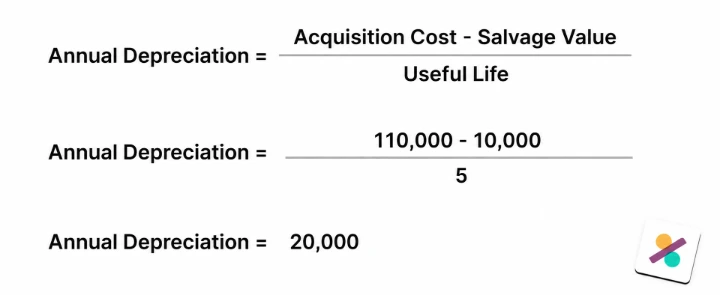
Every year for five years, a depreciation expense of 20,000,000 will be recorded on the income statement, while the book value of the truck on the balance sheet will gradually decrease.
Managing Depreciation Easily with Odoo
Manually calculating asset values and creating monthly journal entries can quickly become a bottleneck for accounting teams. This is where Odoo Accounting changes the game.
Automated Asset Creation
When you confirm a vendor bill for a new asset (like a company vehicle or laptop), Odoo can automatically generate the asset record based on predefined asset models.
Instant Depreciation Boards
Based on your chosen method, whether Straight-Line, Declining Balance, or Units of Production, Odoo instantly calculates the depreciation schedule and visualizes it for you.
Automated Journal Entries
No more manual bookkeeping. Odoo automatically posts the depreciation entries to your general ledger exactly when they are due (monthly, quarterly, or annually).
Real-time Financial Reporting
Your balance sheet, profit and loss statements, and tax reports are updated automatically, ensuring you always have a realistic view of your company’s financial health.
By using Odoo, businesses eliminate human error, stay tax-compliant, and can focus on growth instead of spreadsheets.